St Nicholas parish
The faith
On the Orthodox faith and teaching
or simply "on the right faith"
by Anders Oksavik
Let us begin with a little etymology.
Orthodox
is a Norwegian rendering of the Greek
ορθόδοξος
(ortodoxos) which means
right faith
or
right-believing
. The Greek word is composed of
ortho
which means
right
and
doxos
which means
dogma
or
faith
. This word was taken into use early in the Church's history in order to distinguish between correct faith and incorrect faith. At that time the word was probably used as a quality, whereas today, because of its frequent use and the constant need to distinguish between different churches, it is used as a proper name. Thus we are
the Orthodox Church.
One can also grasp something of the meaning behind the word in the Church Slavonic translation, where they do not say Orthodox but Pravoslavnjie. Which can be translated as
right worship
. Thus not only a right faith, but a right mindset, attitude, and outlook toward the Holy.
We do not say this because we have an unnatural need to mark ourselves off, or an urge to be right about everything, but because we truly believe and hold, and can demonstrate, our right faith. Some today would have it that it is not so important, but then they probably do not look closely enough at themselves. If there is not so much that separates us, why then is not everyone a member of the same church? There are today endlessly many factions of church communities, and each of them must necessarily hold that they have something special that the others do not have. Why else are they not part of the same church?
And here we approach the core definition of the Orthodox Church. It is not a place, or tied to a person or to objects. The Church consists of those who have
the right faith
. And here one must note that the Norwegian word for faith is probably a little narrow, since one might well also bring in the Greek Ortopraxis. That is, not only right faith but right practice. So: all who believe rightly and practice rightly are part of the Church. That means, for us, that we can know who is a member of the Church through membership and earthly ordinances, but we cannot know who is a member in the Church without being part of the earthly ordinance.
The best example here is
Athanasios contra mundi
which, in a church dispute in the fourth century, was quoted thus, when he was confronted by people who said: "Athanasios, the whole World is against you!" Saint Athanasios then answered: "Then I am against the World." We must here interpret "the World" to include large parts of the Church, which the church historians also write. At this time the heresy was so widespread that perhaps only St Athanasios was left who held to the right faith. But once again it was set right, and the Lord's words to Peter gained renewed significance:
And I tell you: You are Peter; on this rock I will build my church, and the gates of the realm of death shall not prevail over it.
What rock is it on which the Church is built? The Catholics will claim that it is Peter himself. We know that it is
the right faith.
This is, however, a great stumbling block, and there is no one among the Church's saints or teachers who recommends assuming that one is a member without having to physically become a member. On the contrary, it is taught almost as dogma that there is no salvation outside the Church, that is, outside the earthly ordinances.
And how does this come to be?
It is so because we have nearly 2000 years behind us of Christian practice in the spiritual life. Here many experiences have been gathered over thousands of lives, vigils, wars, councils, famine, miracles, and everything else that has taken place over the last 2000 years. It would be a terrible arrogance to think that our Lord shall reveal all this to a lone wretch who stubbornly chooses to stand outside the Church. It is precisely through the tradition that we learn and experience our own salvation. And when we step wrongly, we have living teachers in the Church who show us the way back to the right path, without condemnation. For none of the Church's teachers or spiritual fathers will exalt himself above the Apostle who is read every Sunday in the Church:
Christ Jesus came into the world to save sinners, and among them I am the greatest.
What, then, does the Church's faith and practice consist of?
This question is far too large to answer in a short article. Longer and detailed books on the subject exist in every language. Here we must be content with a few points.
1. Extreme humility
Most of what one practices in the Church is a step in acquiring humility. Without it, all other efforts will be completely in vain, since pride was the original sin that drove Adam and Eve out of Paradise. That is, pride led them to trust in their own excellence (..and you shall become like gods..) and thus to break God's commandment not to eat from the one tree. If one then wishes to find the way back to Paradise, one must find the way back to the humility that is so unnatural for us, yet still so good for our soul. One who has lived in both pride and humility can tell how the inner state changes from the one to the other. A proud inner life is like a slimy cactus. Ready to sting and spoil every situation. The humble inner life is like a glowing lamp that warms and gives light for other people. To attain this state one must have fasting and obedience.
2. Fasting and obedience
Because Adam and Eve did not fast in paradise, we today have an inclination to follow our own will (note: the Orthodox Church does not hold the Roman Catholic "original sin" that is inherited. Only an inclination to sin) and not to be obedient. Therefore the Church imposes on itself to fast at set times of the year and to abstain from much of what the modern world regards as goods. What fasting means for each person varies greatly, but the Church has set forth a calendar that is followed in the monasteries and that laypeople can and should follow to the extent they are able, under the guidance of their spiritual father. This means, among other things, that before Easter we fast for 40 days from animal products. By obeying the Church and not one's own stomach or palate, one grows in faith in God's life-giving powers to the extent that one endures ("But the one who endures until the end, he shall be saved.") and comes to experience with one's own senses that "Man does not live by bread alone, but by every word of God." The one who fasts will also come to experience that fasting without God is useless, and is thus "forced" to choose continually.
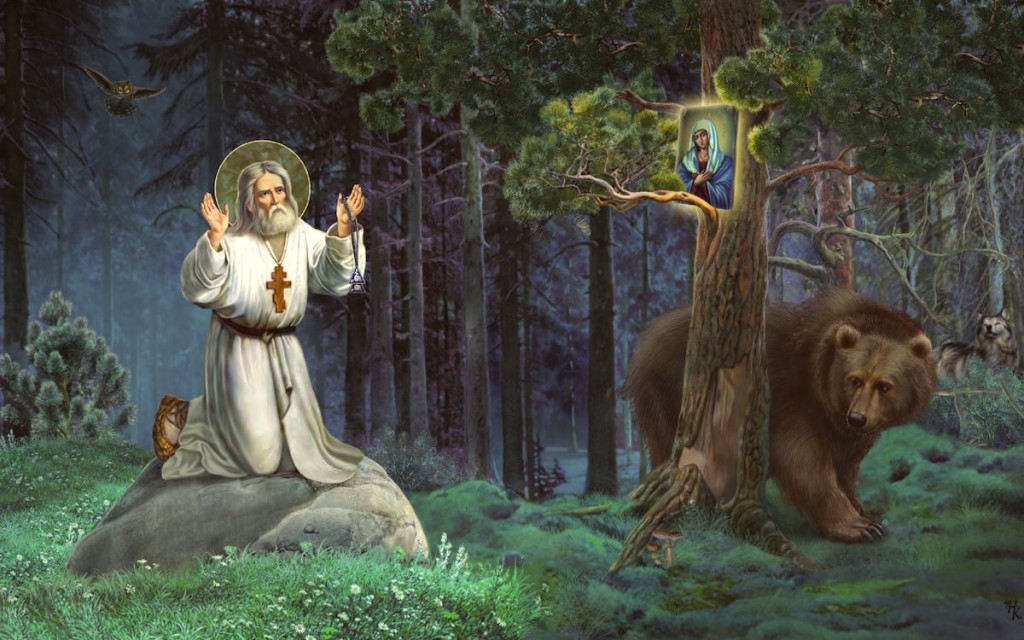
The best modern example we find in Saint Seraphim of Sarov, who for 1000 days kept vigil in prayer on a stone in the forest in the Tambov region of Russia. And when he became too weak, he moved the stone into his hut and continued there to keep vigil in fasting and prayer. We dare to call such men and women Saints, not necessarily because of great wonders that they perform, but just as often because of their insight into other people's lives. As with Seraphim of Sarov in the 19th century, St Paisios the Athonite in the 20th century, and Ilya Nozdrin in our century, thousands of people came hastening from all over the world to seek counsel and comfort from these holy people. It is said that wonders and miracles are not given so that people will come to faith, but that people's faith brings with it wonders and miracles.
3. Prayer
What is a life in Christ without prayer, if not a shell without content. Our life is given by God himself:
Before I formed you in the womb, I knew you, before you were born, I sanctified you..
But our attention is drawn away from him in all the amusements of the world. In prayer, attention returns to God, back to our origin and our final destination. For the past does not exist, nor does the future, only the now and eternity. So seek God in the now and attain Him in eternity, and
Pray without ceasing.
But what is it to pray, perhaps asks one who is new in the Church? What shall I pray for? A new car, a new house, or to become good at football?
No.
Pray to God that you may come closer to him. Our prayer is not so that God will come to us and give us things in this world, which is perishable. Our prayer is a cry for help to step out of the world and into the Heavenly Kingdom, which is within us. Our prayer is a step toward God, and if we take one step toward Him, he takes a thousand steps toward us.