St Nicholas parish
St Tryphon skete
Holy Tryphon Skete
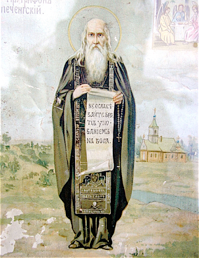
The Life of St Tryphon →
Holy Tryphon Skete
by Father Johannes
Holy Tryphon Skete
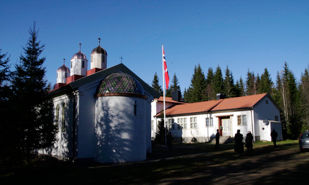
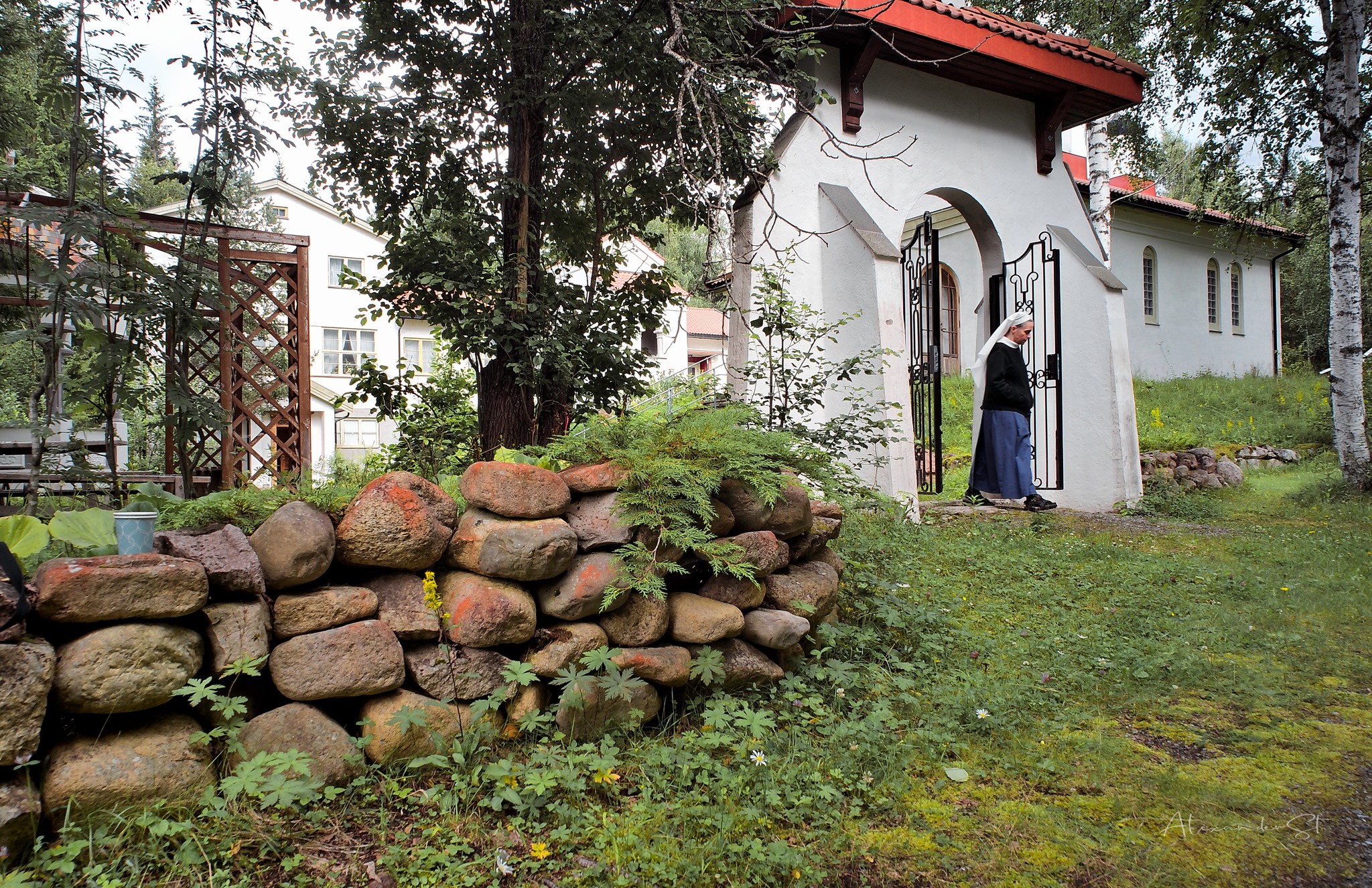
Holy Tryphon Skete in Hurdal is a small monastery attached to the Orthodox Church in Norway, St Nicholas Parish. After an initial period from 1976 in Oslo, the monastery was established at Sivesind (V-Toten) in 1985. Later (the year 2000) it moved to Skabland in Hurdal. The skete is a mini-monastery, the middle way between the institutional monasteries and the hermit life. In this case the community consists of two monks: Archimandrite Fr. Johannes and Hierodeacon Fr. Serafim.
Our work is marked by parish work, in addition to the prayer and the services, the production of beeswax candles, and publishing activity (see the list of literature).
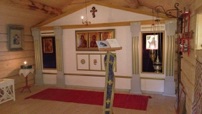
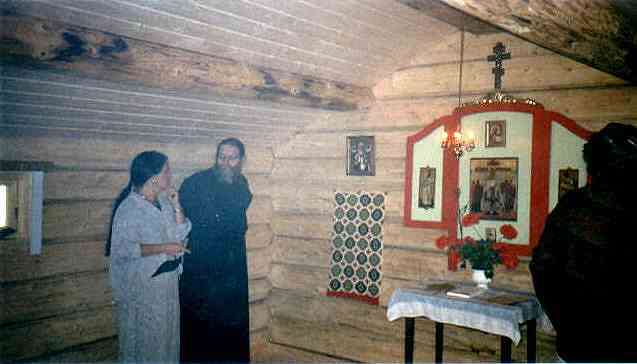
The monastery consists of the main building, where we live and where there are rooms for gatherings: seminars, courses, and fellowship after the services. Further, the forest chapel of St Seraphim of Sarov, which was consecrated for the 100th anniversary of his canonization in 2003, and the church in honour of "the Life-giving Trinity and the memory of St Tryphon of Pechenga". (Consecrated 2010). In 2011 a bell tower will be raised in connection with the church.
The monastery is consecrated in honour of the Russian saint Tryphon, the monk who missionized among the Skolt Sami in present-day eastern Finnmark in the 16th century and who, among other things, built St George's Chapel in Neiden (it comes under St Nicholas Parish). This is both because we wish to stand in the same tradition as he, and also because we are in a certain sense connected with his work, and because we wish to continue his work.
We invite people to celebrations three times a year: 28 December for St Tryphon, 12 July for the holy apostles Peter and Paul, and 1 August for St Seraphim of Sarov.
Skete of St Tryphon
The Skete of St Tryphon of Pechenga in Hurdal, outside Oslo, Norway, is a small monastery in
The Orthodox Church in Norway
. After a preparatory period from the year 1976 in Oslo, the monastery was founded in 1985, and the brotherhood so far consists of two monks. One is a priest, the other a deacon, which means that our work takes place mainly in the parish, but we celebrate the weekday services in the monastery, where the parish office is also located. There too is the candle "factory", and our publishing house.
The monastery itself consists of several white-stone buildings. The old building (1954), where we live, where the library, the office, a hall for various gatherings, the candle factory, and the refectory are. The church "In honour of the Life-giving Trinity and in memory of St Tryphon of Pechenga" (2010) and the bell tower (2011). In the forest stands a chapel in honour of St Seraphim of Sarov (2003).
The monastery is consecrated in honour of the Russian saint St Tryphon of Pechenga, who preached Christianity to the Lopars on Kola and in northeastern Norway in the 16th century, and among other things built a chapel in honour of George the Victorious in 1565 (and it is preserved to this day).
Three times a year we invite people to celebrations. Namely 28 Dec (the day of St Tryphon), 12 July (the day of the holy apostles Paul and Peter) and 1 Aug. (the day of St Seraphim of Sar.
Norway's first Orthodox monastery
Holy Tryphon Skete 1985-2015, 30 years
St Tryphon
was a monk who came from the Novgorod area to the regions of the Arctic Ocean, founded a monastery, and missionized among the Skolt Sami. He worked, among other places, in areas that at that time were no man's land and everyman's land, that is, it was the land of the Skolts, but there was no state authority here. Not until 1826, when the border between Norway and Russia was drawn. This means that St Tryphon worked in areas that would later be defined as part of the Kingdom of Norway. And that in turn means that he, in a manner of speaking, also belongs to the Orthodox history in Norway.
For us Orthodox in Norway, and especially for St Nicholas Parish, St Tryphon has particular significance. The founders of the parish came from St Tryphon's regions, Murmansk, Archangelsk, where there was particular veneration for St Tryphon, and this is also mentioned in the founding papers of the parish. Furthermore, the parish has St George's Chapel in Neiden, which was built by St Tryphon in 1565, in its care, something we are very proud of and glad about. For the monastery he is of great importance as our local monastic example, and dramatic events in the history of the Petshenga monastery are recorded in documents in Norwegian archives. It became natural to choose St Tryphon as the monastery's protector, intercessor, and example.
St Tryphon's skete, or monastery, lies well hidden in the forest in Hurdal, and those who find their way to the monastery discover a complex of buildings that is reminiscent more of other places in the world than of Norway, even though much has been done to give the whole a Norwegian character after all. And this, then, is the first or oldest Orthodox monastery in Norway. There are not many residents here. The brotherhood is small, but actively and energetically occupied with fulfilling its duties and its tasks.
How did it end up here, and how did it come into being?
The monastery has a prehistory that is worth sketching, since it is not without significance for what the result became.
The prehistory:
In 1969 Rolf Johansen travels from Arendal to Nya Valamo monastery in Finland, with the blessing of Archbishop Paavali. There he was taken care of in Kuopio by Bishop Johannes, who accompanied him to Valamo monastery. At Valamo he became cell-servant (kelejnik) to Igumen Simforian, and was also given the task of assisting in the church during the services, baking prosphora, and ringing the 13 bells (of which the largest is 1600 kg) for the services. And the services began at 2:30, and the new "ponomar" had to get up at 2 o'clock to prepare what was necessary. He was also given the task of reading and singing in the services, which were still held in Church Slavonic, so there he learned Church Slavonic. There were 5 elderly monks from old Valaam there, and a very old monk from Petshenga, plus a Finnish novice.
Here the future Fr. Johannes stayed for about a year, and then served his conscription in the Norwegian army, but in 1971 he was back at Valamo. In all he was there about 2 years. And those were two significant years, with a fundamental and thorough introduction to the monastic life. In this way the ground was prepared for St Tryphon's monastery.
St Tryphon's Brotherhood
Later, in 1975, he began theological studies at the Faculty of Theology at the University of Oslo, and this made it possible for him, together with Kjell Sørensen (Father Serafim), to establish "St Tryphon's Brotherhood" in 1976. Fr. Serafim had a long and close collaboration with the rector of St Nicholas Parish, Archimandrite Fr. Therapon (Hümmerich), who gave him training and guidance in the life of the Church. In Arupsgate in Gamlebyen in Oslo they rented two apartments. One as a dwelling with a chapel, and the other for outward-facing activity, such as lectures, seminars, an exhibition, a discussion forum, and the publishing work that was beginning. Here a number of booklets and smaller books on the Orthodox faith were published. Likewise the publication of the journal Ortodoks Røst began. It ran to about 80 A5 pages of theological, philosophical, hagiographical, historical, and liturgical material. In all, 45 issues were published. Both Ortodoks Røst and the other booklets were distributed in large numbers (taking equipment and channels of distribution into account). And many of those who later converted to the Orthodox Church made their first acquaintance with the Church, or deepened their knowledge of the Church, through this.
Holy Tryphon Skete at Toten
In 1980 Fr. Johannes was tonsured a monk by Bishop Roman (Zolotoff) in Nice. Later Fr. Serafim was tonsured by Archbishop Georg (Wagner). In 1985 the property Borstuen at Sivesind in Vestre Toten was bought, and with Archbishop Georg's blessing this became the formal start of the monastery. The property was idyllic, with its high situation by Sivesind-vannet and a view over the Toten districts, with a stabbur from the end of the 17th century, a main house from 1710, a large barn that in time came to house, among other things, the church, and a kårhus from the 1940s that was used as a guest house. The monastery was here for 15 years, until the year 2000.
Holy Tryphon Monastery in Hurdal
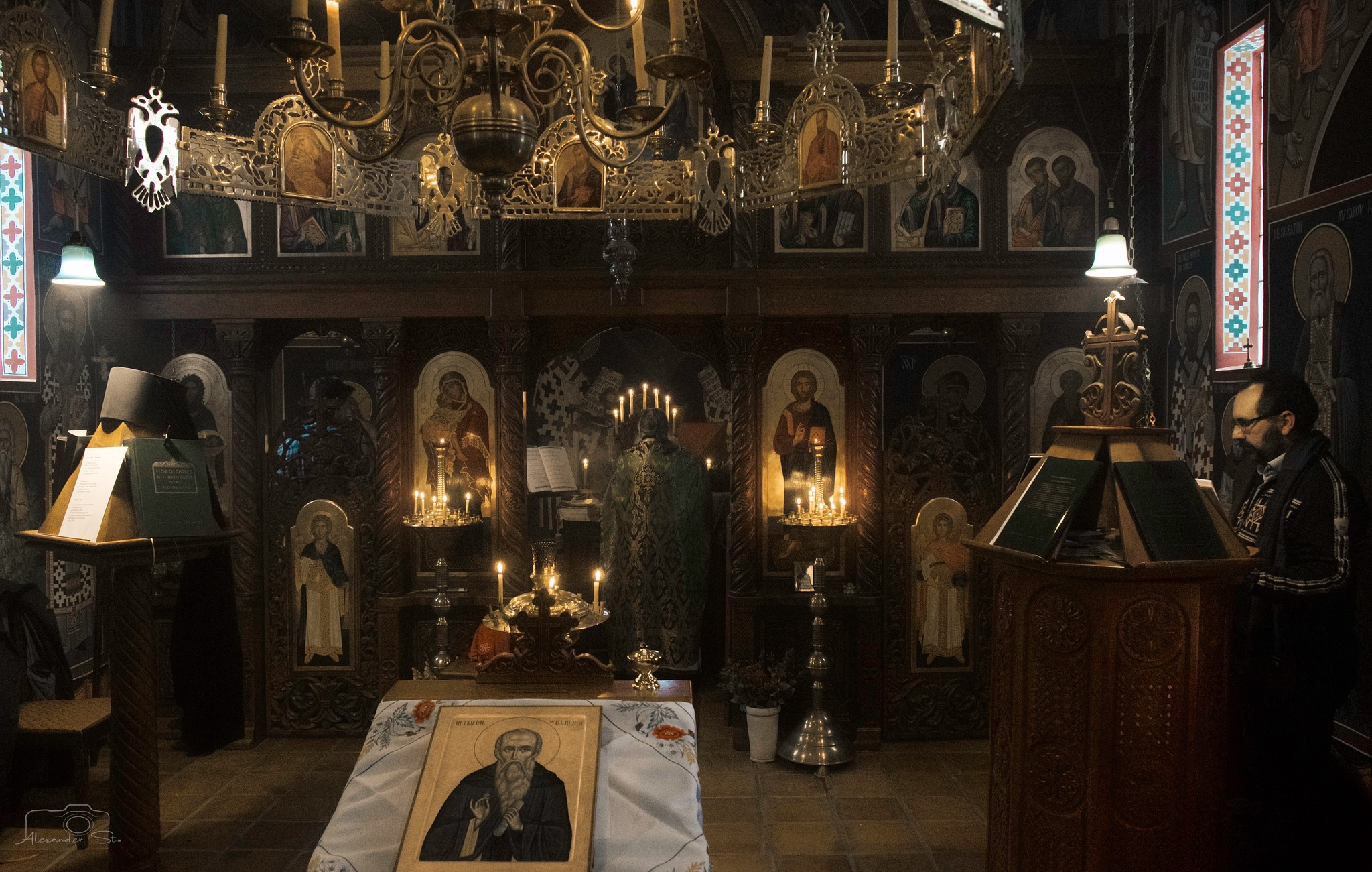
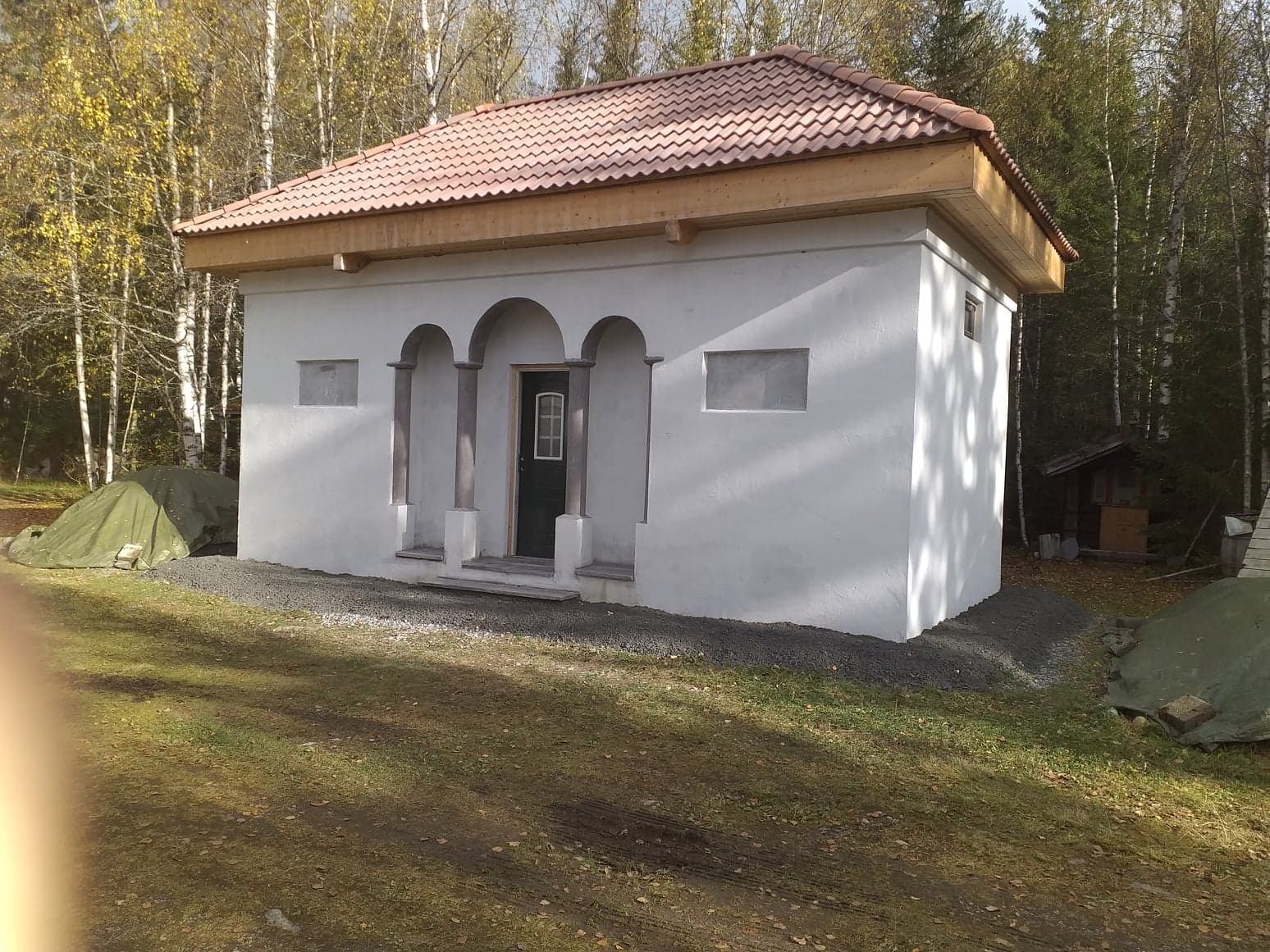
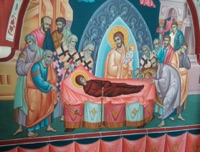
In the year 2000 the monastery moved to a more suitable, if not so picturesque, property in Skrukkelia in Hurdal. A former school from 1954 was for sale. It had been a school for only 7 years. Later it had been both a camp for Indremisjonen and a factory, but it had stood empty for some years. The building was in a somewhat dilapidated condition, but solid, and with many good qualities (in its time it had been raised as a prestige project by the municipality). The monastery moved there. A separate 3-room apartment became the dwelling itself. The rest became church, library, office, candle workshop, and guest rooms. The property, which is 10.5 da of wooded land, was in time built upon with a garage and a woodshed. In 2003 the chapel of St Seraphim of Sarov stood finished for the 100-year celebration of his canonization. It is built as a Russian tshasovna, not unlike the Neiden chapel. Later, in 2010, we had the church finished. It was consecrated in honour of the Holy Trinity and in memory of St Tryphon. It was built after the model of a church in Kosovo from the 1400s. This was in order to show solidarity with the Serbs in Kosovo. Inside, it was adorned with an iconostasis carved in walnut in Beograd. Ove Nikolai Svele painted icons, and likewise an altar and stasidia were made at the same workshop in Beograd. The walls were covered with frescoes that two Serbian artists made. Later we also had a cenotaph (symbolic grave) made for St Tryphon. The remaining furnishings are from Russia and Greece. In 2011 a bell tower was built after a model from Georgia. There a simandron ("signal board") of solid oak has been hung (made by the woodcarver Johannes Rieber) and 8 bells (from 10k to 326k), produced in Ekaterinburg in Russia. A gate after a Romanian pattern was raised at the same time at the entrance to the lower plateau. And in the period 2012-2014 a water-blessing pavilion was built after the model of a corresponding one at Zica monastery in Serbia. Now, at the end, a wall is being built, with a gatehouse and a chapel above, after Bulgarian inspiration, between the church and the dwelling house. It is to be finished for the 30-year celebration in August 2015. Much of this was possible only because two friends of the monastery, Svein and Kirsten Sandvold, made such an unbelievably great effort, both with the building and with the glass decoration.
In this time the work with literature has only increased, and a large number of books and booklets have been published to help those who wish to go deeper into the theological tradition and the spiritual life of the Orthodox Church. It is a way of being missionary without imposing oneself on anyone. The same applies to the seminars and lectures that are arranged. Cultural evenings are another way of helping people come closer to the Church and of freeing them from prejudices.
Another important activity in the monastery is the production of beeswax candles for the services. A large number of wax candles are used in Orthodox services, and Fr. Serafim has in time gained good practice in producing these. It is also an important source of income for the monastery.
The monastic life
The essential thing in a monastery is of course not the outward circumstances and frames, even though they are important enough as a witness to Orthodox monastic spirituality. But then it is also important that such a spiritual core does in fact exist in this. Following the example of St Tryphon, the monastery has all along laid weight on the hesychast tradition. Because of the modest outward frames, it has been necessary to concentrate on content, more than on outward forms. The prayer and the services are what is essential. And in the monastery a large work of translation has been done, which has made it possible to celebrate services in Norwegian every day and on the great feasts. Likewise, work has been done on the musical setting, in which the Old Russian znamenny chant has been the norm.
Evening and morning services are the daily frame around the other work in the monastery. Once a month people are invited to the Liturgy.
Beyond this, it is the Jesus Prayer that has stood at the center, and that will receive still more room in the spiritual life of the monastery. A short presentation and translation of parts of the Philokalia has been made in the monastery, and likewise the tales of a Russian Pilgrim. This too is something that must be set in this context.
Ahead
In 2014 a member of the parish bought a smallholding that had been put up for sale. It borders directly on the monastery, and it was a great relief that the property did not acquire new owners with an entirely different attitude. On the contrary, the new owner wishes it to be of use to the monastery, both as a guest house and as land for cultivation. She has also bought another property that borders on the monastery, where she herself is to live and dwell as a nun. At present she resides at Pokrov monastery in Bussy-en-Othe in France. This too bodes well for the monastery, which unfortunately has not had any real candidates to continue the work. But the future is uncertain. We do our part and place the rest in God's hands.